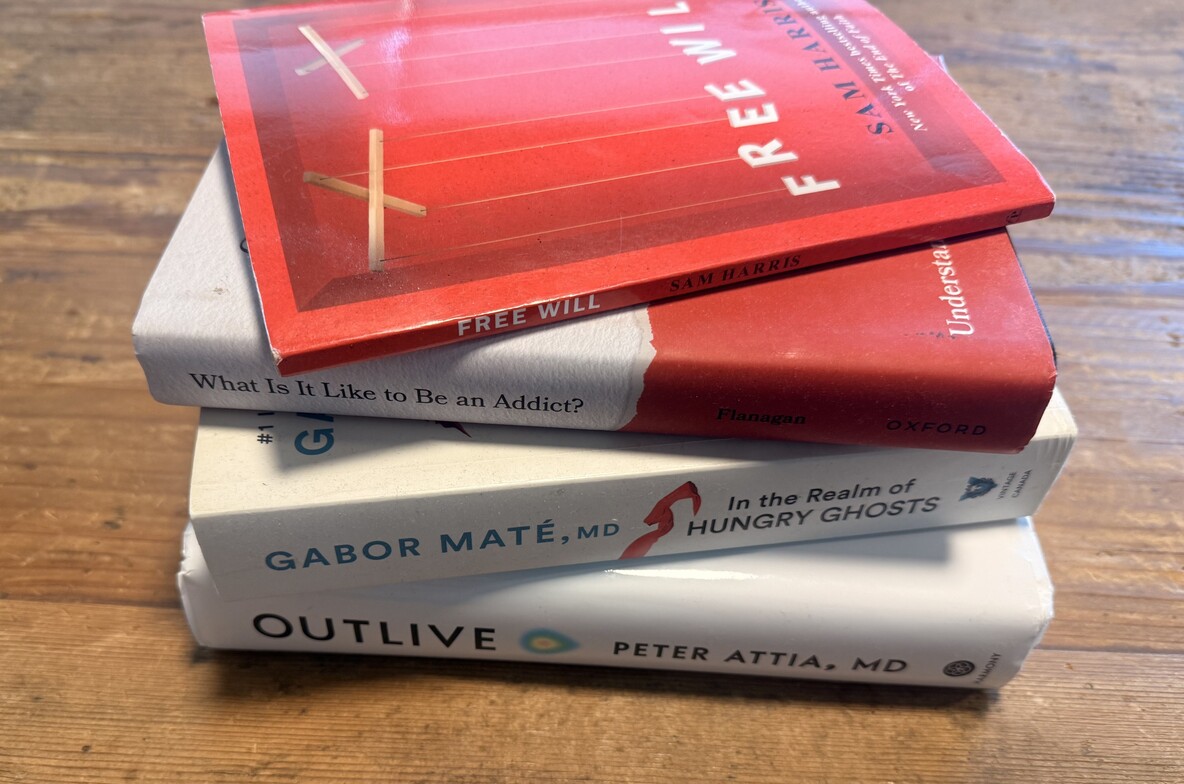
If you're interested in reading, there are a number of books that lend themselves to learning more about human behaviour. In my recovery journey I became obsessed with knowledge. I wanted an explanation for why I did the weird and outlandish things I did. Here is a list of three books and a brief synopsis of their content. I'd love to hear what you think!
1. Man's Search for Meaning (1946) is Viktor Frankl's memoir of surviving Nazi concentration camps, combined with an outline of his therapy, logotherapy.
Frankl's core idea is that humans are driven mainly by a need for meaning. He saw that prisoners who held onto a purpose, such as a loved one, unfinished work, or a responsibility, endured better than those who lost it. Even when everything else is taken away, we can still choose our attitude toward what happens to us. He argued that people find meaning in three ways: through work, through love, and through how they face unavoidable suffering. When meaning is missing, people fall into an "existential vacuum" that can get filled by things like addiction. That link makes the book a natural fit alongside CBT in addiction counselling.
2. Dopamine Nation (2021) is by Stanford psychiatrist Anna Lembke. She explains why constant access to pleasure, from drugs and food to phones, leaves so many people anxious and compulsive.
Her core model is the pleasure-pain balance. The brain processes both in the same place and always tries to rebalance, so every pleasure is followed by an equal pull toward pain. That pull strengthens with repeated use until people need more just to feel normal. Her remedies are:
- A roughly 30-day dopamine fast.
- Self-binding, or putting barriers between yourself and the habit.
- Healthy pain, like exercise.
- Radical honesty.
3. Behave (2017) is by Stanford neuroscientist and primatologist Robert Sapolsky. He asks why people do what they do, at their best and their worst.
His approach works backward in time from a single action. He looks at the brain activity in the second before it, then the hormones of the preceding hours, then the brain changes of the preceding months. From there he moves to adolescence, childhood, the womb, genes, culture, and finally evolution. His core argument is that behavior can't be explained by any one cause. It comes from all these layers interacting, and he warns against simple "it's genetic" or "it's upbringing" thinking. He ends by questioning free will and arguing for a more compassionate, less punitive view of harmful behavior.
Kyle Bickerstaffe
Contact Me